
Liechtenstein, one of Europe’s tiniest countries, is a worthy destination for even the most seasoned traveler. Easily incorporated into a weekend trip through the Alps, it boasts beautiful scenery, interesting museums, and one of the rarest passport stamps to boot. Over the course of my (Alex’s) weekend trip – which took me from Germany to Austria to Liechtenstein to Switzerland – I glimpsed ski jumpers, surprise music festivals, and idyllic castles. This post covers how to plan your own trip through the Alps with some must-see highlights, and how to incorporate Liechtenstein.
What’s Included:
- Where is Liechtenstein?
- How Long Do I Need to See Liechtenstein?
- How Do I Get to Liechtenstein?
- Can I Get a Passport Stamp for Entering Liechtenstein?
- Weekend Itinerary
Where is Liechtenstein?
Liechtenstein is sandwiched between the Western edge of Austria and the Eastern edge of Switzerland. The Rhine River flows along the Western border while the Eastern border is blocked by imposing alp mountains. This principality is Europe’s fourth smallest country (after The Holy See, Monaco, and San Marino) yet also one of the richest and with one of the highest standards of living in the world.
How Long Do I Need to See Liechtenstein?
Liechtenstein is incredibly beautiful, but unless you are going skiing or stopping in one of its many casinos, a day should be sufficient to explore its main attractions in Vaduz, the capital. If you have more time, the entire country can be covered in just two or three days. I recommend incorporating Liechtenstein into a quick weekend tour. This will let you see the highlights of Liechtenstein and incorporate short visits to some other interesting towns through the Alp belt.
How Do I Get to Liechtenstein?
There are many lovely cities surrounding Lichtenstein. Zurich is about one and a half hours away (driving) and makes an excellent base if you’re staying in Switzerland. However, I took this trip from Munich, which is the perfect place to start if you are passing through on an international flight and can afford a weekend before returning home or reaching your planned destination. The entire trip can be performed on public transport so you can avoid the hassle and expense of renting a car.
Munich is one of my favorite cities and you can read more about the things to do in Munich in my post with Emilia. But if you can peel yourself away from Munich for a weekend, this weekend trip to Liechtenstein will give you a sampler of jaw-dropping Alpine landscapes.
There are many ways to do this trip and many amazing towns and cities to visit along the way. But some highlights that you are sure to want to visit are Innsbruck, Austria, a former winter Olympics city; Feldkirch, Austria, a medieval town, and your jumping off point to enter Liechtenstein; and Vaduz, the capital of Liechtenstein.
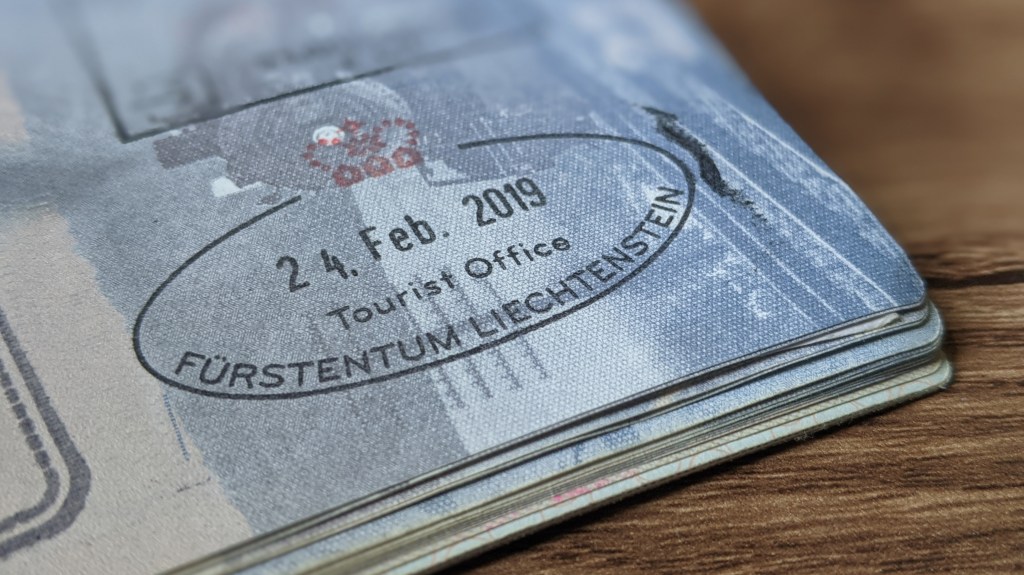
Can I Get a Passport Stamp for Entering Lichtenstein?
Liechtenstein has no airport, seaport, or even train stops. It is a member of the EU, as are its neighbors, making it part of the Schengen Area. This all means that there is no way to get a passport stamp when you enter Liechtenstein. There are simply no border checks!
But, Liechtenstein’s tourist office has you covered. For just 3 CHF (about $3) they will sell you a stamp to prove that you visited! Although more costly than your average passport stamp (free), you can wow your friends and family with your worldly adventures. There’s a myth that ‘souvenir stamps’ invalidate your passport, but this isn’t true. I picked up one of these coveted stamps and never had an issue using that passport afterwards.
The Best Liechtenstein & Alpine Sightseeing Weekend Itinerary
Here is my recommended itinerary. But remember, there are many small towns and worthy stopping points throughout the Alps if you want to customize or extend your trip.
Saturday Morning
Start your weekend on the 7:30am train out of Munich, bound for Innsbruck. The journey will take about an hour and a half and you can snag a one-way fare starting at $30, so long as you book in advance.
Innsbruck is a city of about 130,000 people located in the Wipp Valley in Western Austria. It is an excellent location for winter sports given the steep mountains surrounding it. It’s even hosted two Winter Olympics. These steep mountains provide a surreal backdrop to a picturesque European city.
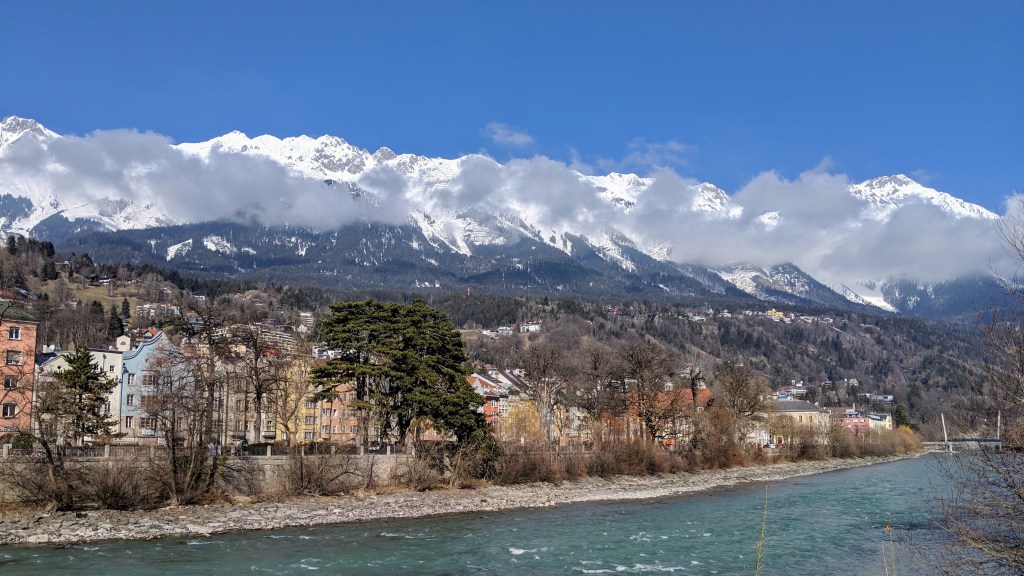
Although Innsbruck can be stretched into a multi-day trip, it is perfectly possible to see the highlights in a single day. The train drops you into the heart of Innsbruck. From there, head south towards the Bergisel Ski Jump. If you are lucky, you may visit on a weekend when there is a competition and you’ll be able to glimpse intrepid skiers performing long jumps. (Although this means you may not be allowed up the ski jump to the viewing decks.)
On your way to the ski jump, stop to admire the Stift Wilten monastery. If you are a history buff, pop into the Kaiserjäger museum to learn about the area’s military history. Depending on how much you want to pack into your Innsbruck visit you may want to skip the monastery, museum and ski jump and instead head straight to the city center. Although the ski jump boasts excellent views of the city, you will have even better views of the city from the Top of Innsbruck – read more below.
Whether or not you stop by the ski jump, make your next step Innsbruck’s triumphal arch, located in the city center. From here head north along Maria-Theresien street, admiring the historic architecture until the street gives way to a pedestrian area. This means you are approaching the old city square, where you’ll find the 15th-century City Tower, which can be climbed for wonderful views of the surrounding area. Also in the square is the Habsburg residence, featuring a gorgeous Juliet balcony with a gold-plated roof. The city center blends a unique medieval and modern European aesthetic that is not to be missed.
Take lunch anywhere in the historic downtown, preferably in an outdoor café where you can enjoy the weather and people-watching.
Saturday Afternoon
Depending on the time you have allotted in Innsbruck, see any of:
- The Hofburg imperial palace, a 16th century palace, which looks plain on the outside, but contains rooms rich with ornate decoration and royal portraits.
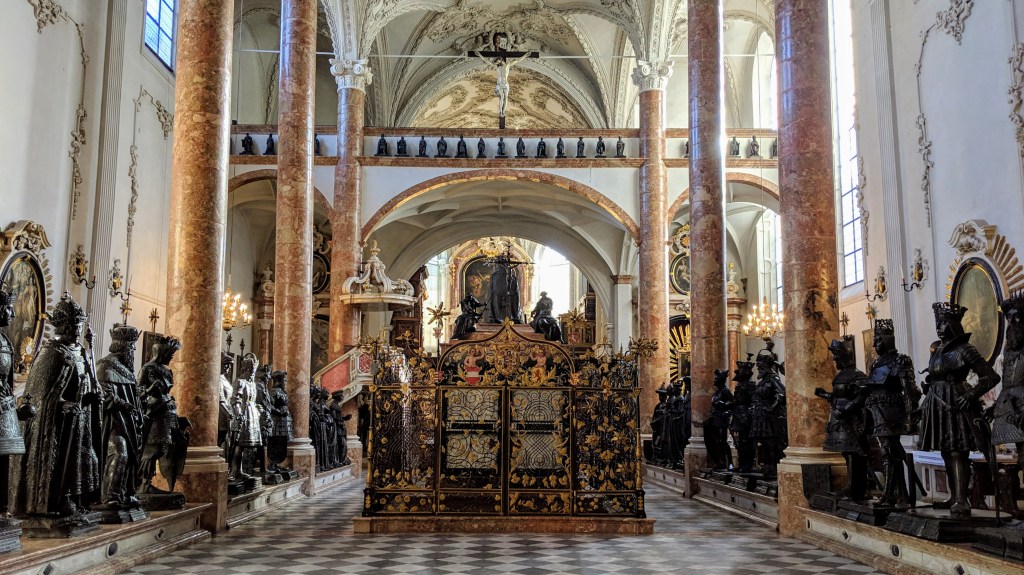
- The Hofkirche court church, a small but highly ornamental chapel featuring larger-than-life bronze statues of famous emperors, kings, and queens. It’s also the resting place of Archduke Franz Ferdinand, whose assassination lead to the start of World War I.
- The Tiroler Landesmuseum, a museum with exhibits tracing the history of Tyrolean culture and arts.
Doing all three of these activities, plus the next activity (my personal favorite) may be too much for one day. The Hofkirche court church is a quick visit, but each of the other options may take an hour or more depending on how long you want to look at the exhibits.
Above all else, do not miss my favorite attraction in Innsbruck, which is the Top of Innsbruck. The Top of Innsbruck is the very top of Hafelekarspitze, a 2300m tall mountain that towers over Innsbruck and the surrounding valley. Views from here are sublime, and you can reach it in no time at all.
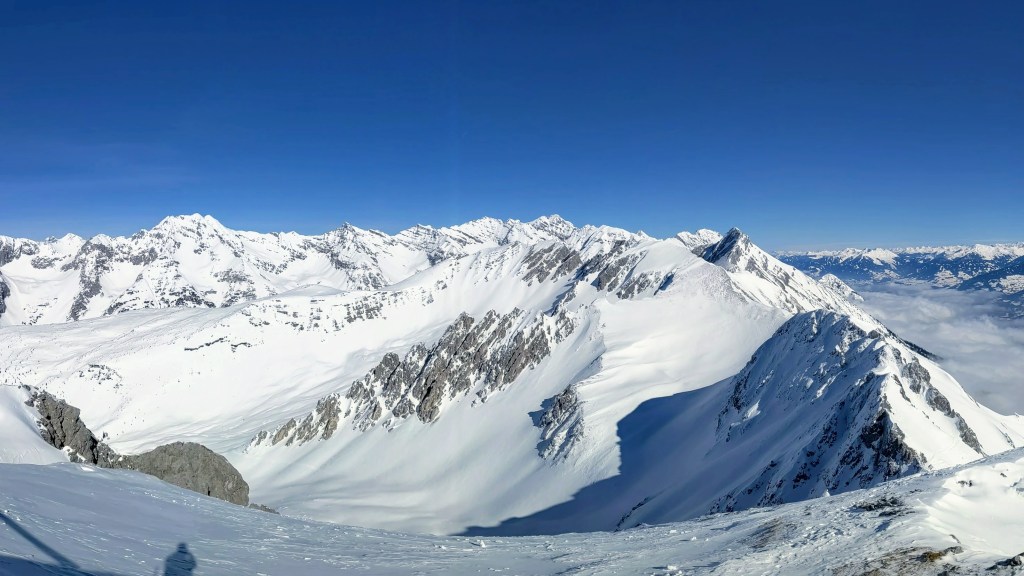
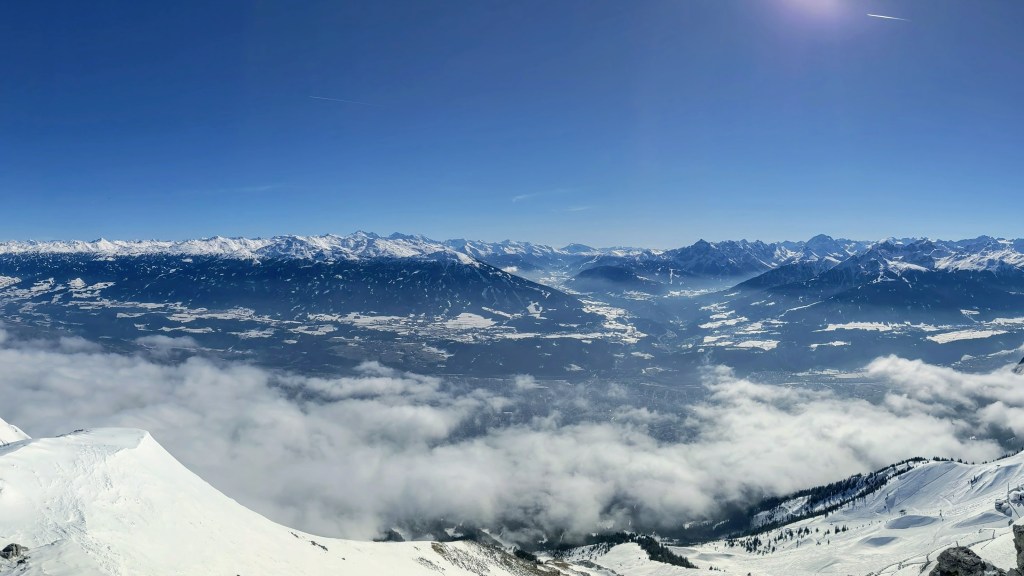
From the heart of Innsbruck take the Hungerburgbahn funicular up to Hungerburg, perched in the high foothills of Hafelekarspitze just North of Innsbruck. From here take the cable car (along with many skiers and snowboarders) to the Seegrube, and then take the second cable car to the peak of Hafelekarspitze.The round trip price of the journey is €40 (about $50) but is well worth the money. From the top soak in the bucolic views of Innsbruck and the surrounding Wipp Valley. Then turn around and look out over the rugged Karwendel Nature Park, where you will see soaring birds of prey above endless mountain ridges.
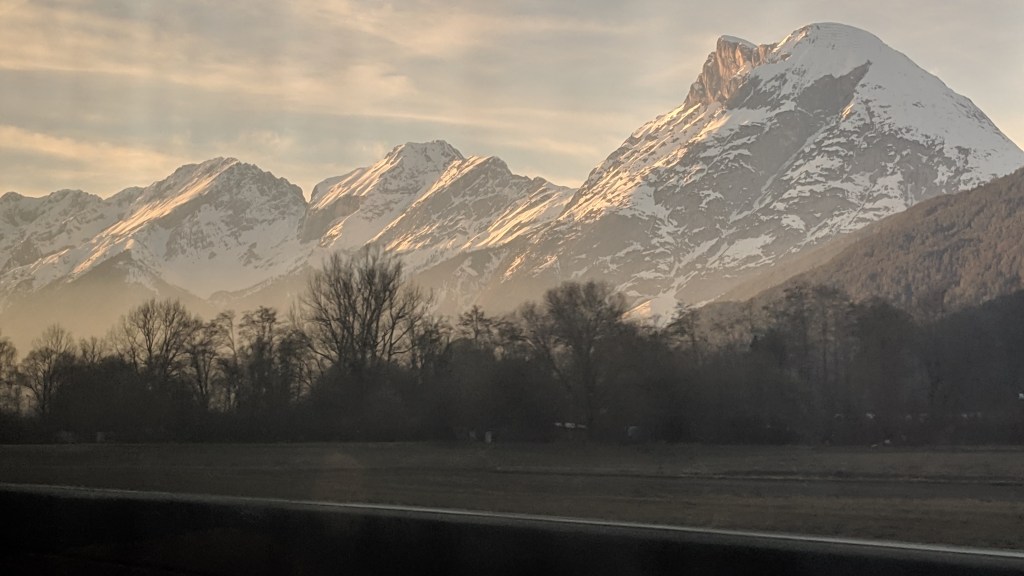
You should be on your way to Feldkirch between 5:00pm and 7:00pm so that you have time to get dinner and settle in for the next day of adventure. Trains leave from Innsbruck to Feldkirch almost hourly and the trip takes about two hours, with one-way train tickets starting at approximately $40. You will want to catch the train while it is still light out so that you can see the Wipp Valley as the sun sets; if you sit on the right side of the train you will be able to see the mountains on the North side of the valley painted in pink and red hues. If you took the early train from Munich to Innsbruck (arriving around 9am), you should have about 8 hours in Innsbruck, so budget your time at each attraction accordingly.
Saturday Evening
Feldkirch is a quiet town of about 30,000 sitting in the furthest Western reaches of Austria, right on the border of Liechtenstein. On arrival, you will find that there is some night life in the city, but do not expect to be out on the town too late. The small town center is host to several bars and restaurants, with most closing between 11:00pm and 1:00am. However, before you head to dinner, you will probably want to drop your bags at your hotel.
Despite being small, Feldkirch has a number of hotels around the old town. Airbnb is also reliable and may allow you to find excellent rooms at half the cost of a hotel. I highly recommend using Airbnb to stay at Villa Müller’s, a beautifully appointed house featuring five guest rooms decorated in 60’s style. Although at first Villa Müller’s may seem out of the way (especially because you need to climb about 200 stairs from the old city center to reach it), the rooms offer the most spectacular morning vistas over the city and out into the valleys that extend away from Feldkirch.
After depositing your bags, wander into the old town to get dinner and see the town at night. RIO Kino Pizza Bar stays open later than most places and is a gathering place for many young people who stop in for drinks or even to catch a movie at the small theater tucked inside. Don’t worry about staying up too late! If you are doing this trip on a weekend, the next day is a Sunday and Feldkirch, being as small as it is, gets off to a slow start.
Sunday Morning
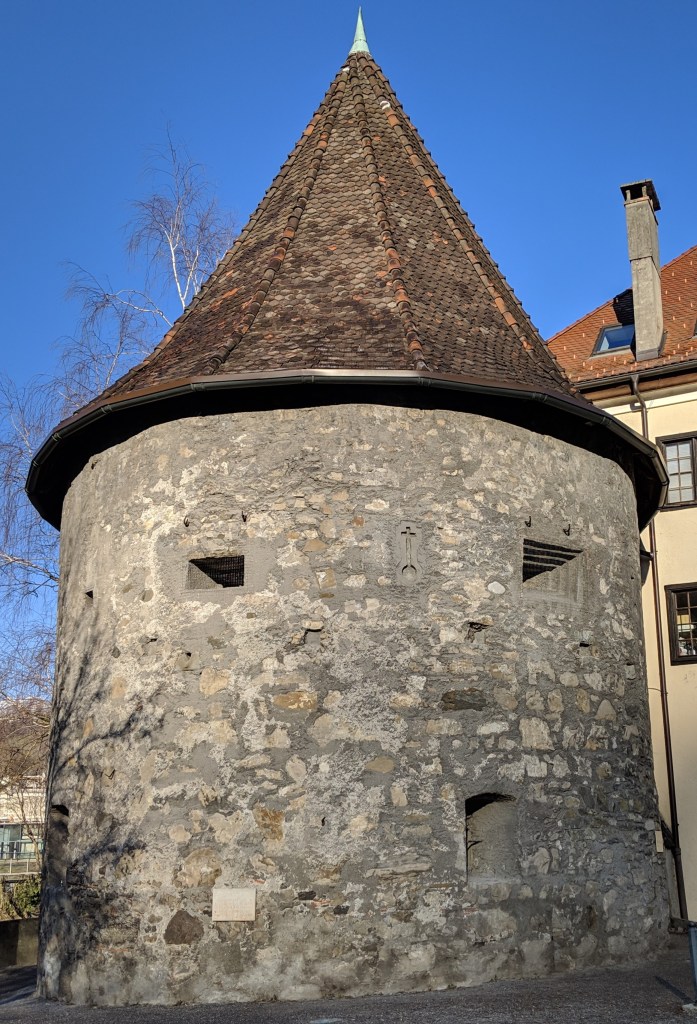
The following morning, spend some time in Feldkirch. Stop in the 12th century Schattenburg castle, which opens at 11:00am on Sundays. It has both an interesting museum with a variety of furnishings, artworks, and armaments ranging from the historic to the near-modern, as well as beautiful views of Feldkirch and the surrounding area. The museum is not large and will take you at most two hours.
Head from Schattenburg directly to the train station where you will pick up the LIEmobile bus, Liechtenstein’s nation-wide public transport system, to Vaduz, the capital. The busses are a notable (and unmissable) lime green. The trip takes approximately 30 minutes and takes you through several small modern towns and through Liechtenstein’s farmland along the Rhine River.
If you sit on the right-side of the bus, you’ll be looking across the Rhine at mountains in Switzerland. If you sit on the left-side of the bus, you will watch the Drei Schwestern mountains pass by – the mountains that separate Liechtenstein from Austria. In either case, the steep mountains contrast with the otherwise flat farm landscape surrounding the banks of the Rhein and make for epic photographs.
Grab lunch from the city center to eat on the bus, or take lunch on arrival in Vaduz.
Sunday Afternoon
The LIEmobile bus will deposit you directly in the city center. The main strip of Liechtenstein runs parallel with a pedestrian street lined with the major museums and sights in Vaduz. Your first stop is the Liechtenstein Tourist Center, where you can procure the rare Liechtenstein passport stamp. Grab a few souvenir gifts for friends and family while you are there so as to remind them how cool you are (I got Emilia a mug, which she says is the perfect size for tea).
In thinking about your trip, note that at the end of your visit you should find yourself in Buchs, Switzerland, which has the nearest train station with service back to Munich. The last train from Buchs leaves around 5:45pm, so budget your time accordingly.
While in Vaduz, we recommend seeing:
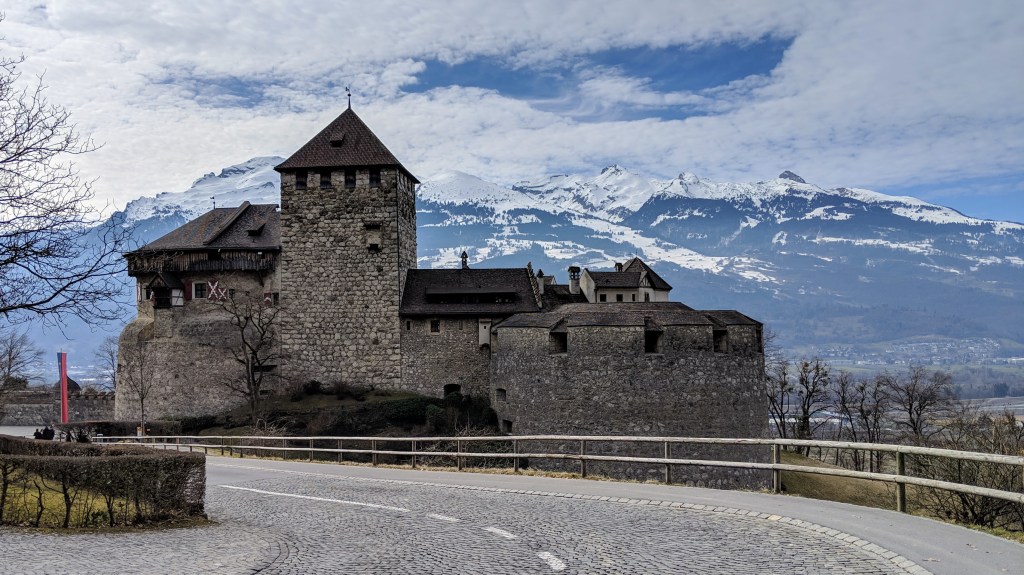
- Vaduz Castle. The home of the prince of Liechtenstein is perched just above the city center and requires a 20 minute hike ascending about 400 feet. Although the castle cannot be visited, the mountainside surrounding the castle and view over the valley are splendid. (If you prefer a slightly longer hike but a more gentle ascent to the castle, pass by the Red House, a 14th-century house sitting just 10 minutes walk north of the city center, then cut back up the mountain towards the castle.)
- Postmuseum. This is a small but well-populated stamp museum. Niche? Perhaps, but it’s a fun visit if you are interested in the design and printing of stamps.
- Kunstmuseum. This is the main modern art museum of Liechtenstein, with a surprising breadth of art, although due to the limited size, not much depth of art on any single artist.
- Regierungsgebäude. This is the main government building of Liechtenstein, used for a variety of government activities throughout Liechtenstein’s history. You’ll find the Landtag state parliament building adjacent, which contrasts greatly in architectural design. Both are visually interesting and worth a detour.
- St. Florin Cathedral. Vaduz’s main cathedral is situated just south of the Regierungsgebäude and unmissable given its elevated position off the main street. It’s a gothic style building with mesmerizing, colorful stained glass windows.
Once satisfied with the sights that Vaduz has to offer, if you have time remaining before your return trip, I highly recommend walking into Switzerland via the Old Rhine Bridge, the only remaining wooden bridge spanning the Rhine. Although not remarkable in and of itself, the bridge lets you cross the Rhine and walk into Switzerland, unhindered by passport control. This is the nearest crossing point from Vaduz city center into Switzerland.
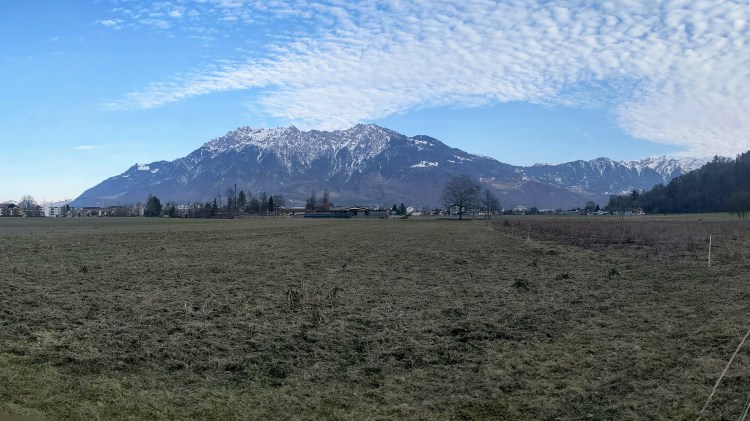
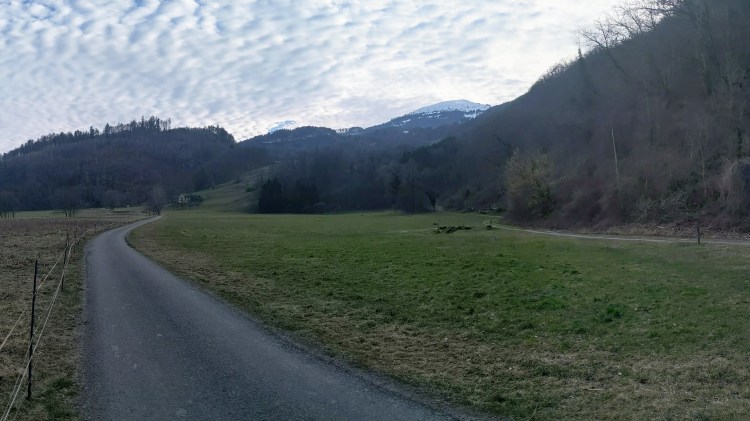
Once you’re in Switzerland, you can walk along the elevated path that runs alongside the river bank, or cut inland and roam the quaint farmlands on the outskirts of Buchs. If time permits, hike to the waterfall Rietli located halfway between the Old Rhine Bridge and Buchs city center. Hiking here will take you into the foothills of the mountains on the Swiss side of the Rhine where you will see postcard-perfect barns, houses, and meadows. No matter where you go, as you take in the snow-covered mountain peaks set above perfect green and grey fields, you will feel like you are walking through a scene in The Sound of Music (although the movie takes place in Austria).
As I mentioned, your walking tour should leave you at the train station in Buchs in time to catch your train back to Munich. I do not recommend arriving much earlier than your departure time as Buchs, despite it’s charming setting, does not have many sights worth stopping to see. Train tickets to Munich start at about $50 but can range in price up to $90 depending on the time of day and number of transfers. Any train trip to Munich from Buchs will require at least one train transfer. The trip takes about 3.5 hours, although it can take longer depending on the number of transfers and the train route.
Take in the Alps one last time as the train whisks you back up the Rhine.
 Roam The Reaches