
When it comes to planning a bucket list trip to Namibia, our top tip is to start planning now. Even if the most concrete part of your trip is daydreaming about sky-scraping sand dunes.
Organize the logistics far in advance – a year out at the minimum. This means that, when it’s time to book , you’ll know exactly how long you’ll need, what you want to see and where you want to stay.
We benefited from an extended planning period, albeit accidentally. In January 2020 we booked our Namibia vacation. Fast-forward to our intended departure in August 2020 and we couldn’t visit due to border restrictions. We moved our trip to August 2021. Deferring our trip gave us time to perfect our itinerary. In return, we had one of our most memorable vacations.
This guide will cover all the questions you should consider in this pre-planning stage. We’ll discuss everything from how much time you need to properly see Namibia, how best to get around, and how much to budget. We’ll also provide you with links to more in-depth information to assist you as you get deeper into planning and have more specific questions.
What’s Included:
- Where is Namibia?
- How Long Do I Need to See Namibia?
- When is the Best Month to Visit Namibia?
- Is Namibia Safe?
- How Do I Get to Namibia? Do I Need a Visa?
- What’s the Best Way to Get Around Namibia?
- Do I Need a 4×4 to Travel in Namibia?
- What Currency is Used in Namibia?
- Will I Need Cash?
- How Much Will it Cost to Visit Namibia?
- What Kind of Accommodation Will I Find?
- Does Namibia Have Good Internet Access/Cell Service?
- How Do I Navigate While Driving?
- Is the Water Safe to Drink?
- What’s the Food Like? Will They Cater to My Dietary Restrictions?
- Other Tips
Where is Namibia?
Namibia is bordered by South Africa to the south, Angola to the north and Botswana to the west. On the east, Namibia faces the Atlantic Ocean. It’s one of the most sparsely populated countries in the world with just 2.5 million residents for an area of 318,772 sq miles. The capital city of Windhoek has 325,000 residents.
Namibia has a unique range of landscapes and climates. The coastal regions, from the Skeleton Coast in the north to Lüderitz in the south, can be chilly and windy, while the highlands around Windhoek remain warm year-round. In the southwest you’ll find the Namib desert, which counts itself among the world’s oldest. In the far northwest reaches, the Caprivi Strip boasts lush wetlands and an astonishing array of animal life. The variations and transition zones between these regions are starkly marked as you traverse the country.
How Long do I Need to See Namibia?
Consider ten days an absolute minimum for your trip. This should give you enough time to visit the highlights and add in a few detours, if you’re feeling ambitious. From this number, the amount of time you spend can go up and up (until your visa expires, that is).
We spent just under two weeks in the country and during that time we visited Windhoek, Etosha National Park, the Skeleton Coast, Swakopmund, Sossusvlei, Luderitz and Fish River Canyon. This involved some very long drives that, in retrospect, we should have broken up.
When you’re organizing your itinerary, it’s essential to consider not only how much time you want to spend in each location, but also how much time you want to spend driving each day. Although relatively compact, the sites you are interested in could take a full day to drive between. Ask yourself: am I okay driving for seven hours, or would I prefer to stop after five? Read our post on Namibia’s road quality for more driving considerations.
If you have more time, or just want to segment longer drives, you could add on a day exploring attractions in Damaraland, a trip to a Himba village in the Kunene region, a few days in the Caprivi Strip or a dune tour from Walvis Bay.

When is the Best Month to Visit Namibia?
We took our trip in late August. We think this is the ideal time to visit if you want to experience the range of what Namibia has to offer. And why wouldn’t you?! Generally speaking, most people advise visiting Namibia during the country’s dry season (winter), which spans from June through September.
The dry season is perfect because, while it gets hot in the middle of the day, the temperatures cap off at around 80-degrees Fahrenheit. Although the landscape is dry and dusty, the lack of foliage means you can more easily spot animals from the road. The lack of water means wildlife congregates to water holes, making this the best time of year to see hard-to-find game. The chance of rain is minimal, and while it can get chilly at night, it’s nothing that a light windbreaker and warm sleeping bag can’t handle.
Do be aware that this is the most popular time to visit Namibia, which means that hotels and campsites book up quickly. Most people book about a year in advance. When we were originally planning our trip in January 2020, we were surprised to find that most places were already full for August. At the moment, this doesn’t seem to be an issue, though all the tourism operators we spoke to felt optimistic that tourism was on the upswing from the pandemic and destinations would soon approach full occupancy.

Is Namibia Safe?
Many people say that Namibia is one of the safest, if not the safest, country to visit in Africa. We never felt unsafe while we were there, with the disclaimer that we were travelling as a couple (i.e., a single woman might disagree with us). The biggest worry for tourists is people breaking into your car. Be sure to book hotels with private secured parking and don’t leave anything inside if you’re parked on the street. Be smart, and you should be perfectly safe.
How Do I Get to Namibia? Do I Need a Visa?
From the US, you can find flights routed through Johannesburg, Frankfurt or Addis Ababa. We flew via Frankfurt, which we liked for the fact that it broke the long journey into two reasonably sized flights (~8 hrs to Frankfurt, then ~10 hrs to Windhoek). Flying through Johannesburg will take about 15hrs, plus a short two-hour flight to Windhoek. Americans are granted a visa on arrival in Namibia, but visitors from other countries should check Namibia’s visa regulations for their country before traveling.
At the time when we travelled (August 2021), to enter the country you need to have filled in a health document, an arrival declaration (provided on the plane), proof of medical insurance with coverage for Covid-19 expenses, and a negative PCR test taken within 72 hours on arrival in Windhoek. These documents were screened in Frankfurt, then shown on arrival in Windhoek. Check the IATA Covid restrictions map for the most up-to-date information.
What’s the Best Way to Get Around Namibia?
Driving is, hands down, the best way to see Namibia. People call it the ultimate road trip destination and it will only take you an hour or two on the road to see why. The landscapes are gorgeous and varied, while cars are minimal. The roads are extremely well marked and, for the most part, very well kept.
When it comes to Namibia, your own car is also the most reliable form of transport. Trains are slow and visit limited places, as do buses. There are some organized tours you can join, but these tend to be highlight reels that ferry you from attraction to attraction with minimal time to linger and explore. If you want to enmesh yourself in the country, you need to drive.
As we discuss in our post on top driving tips for Namibia, being an experienced driver is an asset. This is especially true if you’re planning drives that stretch beyond five or six hours. You’ll be driving on gravel roads and, while our car rental company assured us it was relatively rare, puncturing a tire is always a possibility.
Less experienced drivers will be happy to know that the vast majority of the roads are relatively empty, which makes driving less stressful. You’ll also be driving on the left hand side of the road. While we were worried about this at first, after a few hours of driving, we quickly became accustomed to it.

Do I Need a 4×4 to Travel in Namibia?
Most travellers to Namibia opt to rent a four wheel drive vehicle. The most common model is the Toyota Hilux. This car will be more than capable of taking care of all the challenges the average visitor will face. You’ll be able to drive across the sand at Sossusvlei and navigate the rocky terrain around Fish River Canyon.
If you’re looking to save some money, a two-wheel drive can also take most of what you’ll encounter on the road. You may find yourself limited from visiting some extreme destinations (like Kaokoveld or the Namibian Kalahari), but major attractions (like Sossusvlei) will offer a shuttle or a short hiking route from a parking lot that will take you to your destination.
Another option to consider is whether or not you’ll want to camp. When renting a 4×4, you’ll have the option to get it affixed with a roof tent. We did and we loved it. Not only is it the easiest tent to set up, waking up to a view of the sunrise from your tent is magical. You don’t have to camp every night, but it can help keep costs down. Bonus? Campsites in Namibia offer unparalleled access to some of the country’s most in-demand sights.


What Currency is Used in Namibia?
Namibia’s currency is the Namibian dollar. It’s pegged at a one-to-one ratio with the South African Rand. The Rand is legal tender in Namibia and can be used freely. You’ll occasionally get Rand as change in stores or from ATMs.
You’ll find $10, $50, $100 and $200 notes. You’ll occasionally receive coins, the most useful of which is the $5 coin.
At the time of publish in 2021, $1 USD is equal to approximately $15 NAD.
Will I Need Cash?
You’ll definitely need cash during your trip. Take some out as soon as you arrive at the airport. While many places take credit card, there are some places that don’t, especially places in areas that are more remote. ATMs are easy to find in Windhoek, Swakopmund and Luderitz, but rare outside of cities.
Cash is also useful for tipping, which is a common practice in Namibia. You’ll want small bills to tip tour guides, waiters and anyone who offers to watch your car for you, a common (and, unfortunately, essential) practice in larger cities.

How Much Will it Cost to Visit Namibia?
Visiting Namibia isn’t ultra-expensive, but it’s not the cheapest trip either. Here’s a rough break down of the different costs you can expect.
- Plane tickets: $2000 USD (from NYC). We spent about $2000 per person for our round-trip plane tickets from New York. We bought tickets twice. First in January 2020, then a year later. They cost about the same both times. Our first flight was via Johannesburg on South African Airlines. The flight we actually took routed us through Frankfurt, where we got a direct flight to Windhoek. Expect plane tickets to be one of your largest costs.
- Car rental: $1,900 NAD ($130 USD) per day. The second largest expense will be your rental car. We opted for one of the priciest options: a recent model year Toyota Hilux (4×4) double cab, affixed with camping gear and with an automatic transmission (an essential upgrade for those without manual experience).
You’ll also need to budget money for gas, which gets expensive because you’ll be doing a lot of driving and filling up an enormous tank. On our trip, which took us 4,025 km (2500 miles), we spent approximately $4,000 NAD ($270 USD) on gas.
- Accommodation: between $800 NAD ($55 USD) to camp and $2,000 NAD ($135 USD) per night for a hotel. Accommodation prices range hugely. Camping is the most affordable option, while hotels vary from budget options to mid-range to ultra-luxury. When staying in hotels, we averaged about $130 USD per night and ended up with options that felt quite upscale compared to what we are used to.
Prices also fluctuate depending on the time of year. Staying in the high season (August-Sept) will cost extra, but, as we explain above, we think it’s worth it. Also note that the pandemic has caused many places to drop their prices to encourage business, and these prices are likely to steadily rise back to the nominal rates we listed above.
- Food: $500 NAD ($35 USD) for a restaurant meal for two people, including drinks. To eat out, you’ll pay between $100-150 NAD ($7-10 USD) for a main, between $20-40 NAD ($1.50-3 USD) for a beer or a glass of wine and roughly $40 NAD ($3 USD) for dessert. Portions are quite generous and food is delicious, so it’s well worth keeping money in your budget for meals out.
Grocery prices tend to be on par with what you’d pay in the US for fruit and vegetables, though we found that meat and luxuries like chocolate were slightly cheaper. For more details on food prices, check out our complete guide to camp cooking in Namibia.
- Park entrance fees: $150 NAD ($10 USD) per adult, $50 NAD ($4 USD) per car, per day. You’ll have to pay entry permits when you visit national parks in Namibia. These costs are tallied on a per day basis and paid all at once either when you enter or before you leave the park. Costs are cheaper at smaller national parks, and there are discounts for SADC residents and children.
What Kind of Accommodation Will I Find?
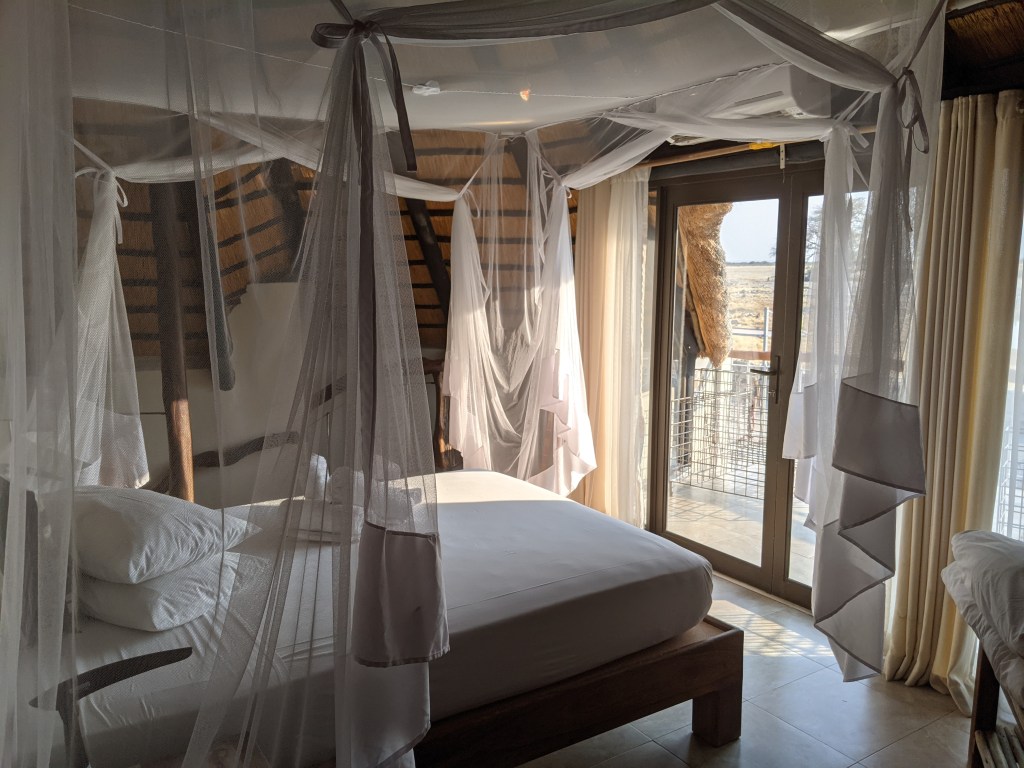
There’s every type of accommodation in Namibia, from campsites to super luxury safari lodges. Your budget will be the limitation here. Some resorts, like the fly-in Shipwreck Lodge on the Skeleton Coast or the Sossusvlei Desert Lodge can fetch up to $20,000 NAD ($1,350 USD) per night.
For the rest of us, a mix of camping and hotels is the best way to maximize your accommodation dollar. Car rental companies offer the option to affix a tent to your roof, which makes for camping with an easy set-up and, since there’s a mattress pad affixed to the bottom, it’s pretty comfortable to boot. The experience of watching the sunrise from your tent and having bird song wake you up is unforgettable.
For less than $2,200 NAD ($150 USD) per night you can book top-notch hotels across Namibia (prices vary slightly according to city). Breakfast is included in the price of most hotels and most also provide wifi access. Other perks we encountered included pools, roof decks, private patios, and secured private parking.
Whether you’re looking for a campsite or a hotel, you’ll have the option to choose between independent properties and ones run by the state tourism organisation NWR (Namibia Wildlife Resorts). The state run lodges are typically located in national parks and offer perks like water holes for wildlife viewing (in Etosha) or pre-sunrise access to dunes (in Sossusvlei).
We’ve heard other travellers comment that NWR lodges don’t have great amenities, but we found them to be well-kept. You have the choice between camping and private chalets at NWR resorts. While camping gives you access to unforgettable settings (like brushing your teeth under the stars at Hobas), chalets are catered with the cost of breakfast and dinner is included. We spent a night at a water hole chalet at Okaukuejo in Etosha and it was one of the nicest hotels we’ve ever stayed in.
Does Namibia Have Good Internet Access/Cell Service?
If you want cell service in Namibia, you’ll need to buy a SIM card from local provider MTC. You can purchase week-long plans that offer varying amounts of minutes and data, according to your needs.
Don’t expect the data you purchase to provide you with online maps as you drive. Cell service disappears between towns, reappearing at hotels and other select locations. We purchased a SIM card to ensure that, if we had an issue and needed to contact our car rental company, we’d be able to do so. Realistically, we used it once and for a minor complaint. The peace of mind it offered was worth it.
Internet access is similarly intermittent. Independent hotels offer wifi, but the quality might not be as fast as what you’re used to at home. We found that we only got a usable signal in common spaces. Frankly, we thought this was a bonus as it made it easier to disconnect.
At NWR lodging, access is more intermittent. At Etosha, each resort offers wifi vouchers to access the internet in communal spaces (reception/restaurant). In Terrace Bay, we had access to free wifi in the restaurant. Both Sesriem Campsite and Hobas Campsite didn’t offer wifi. Our advice is to plan your trip without the need for wifi and you’ll be fine.
How Do I Navigate While Driving?
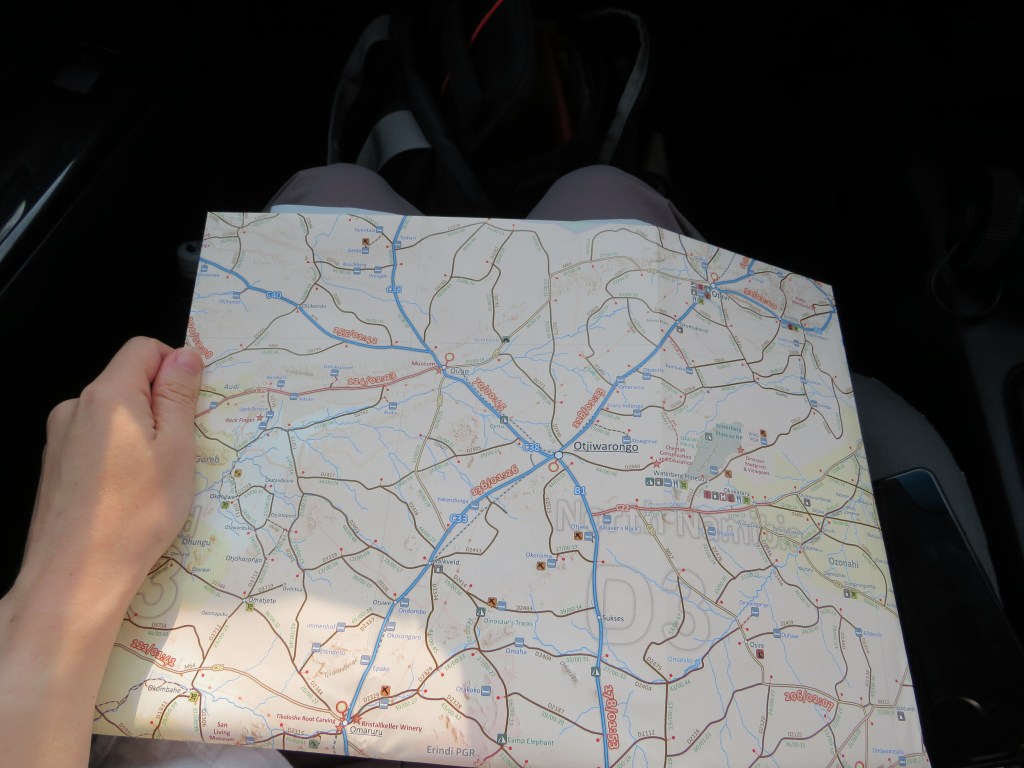
A good map is essential for driving in Namibia. We used the Tracks 4 Africa map and loved it. It’s clearly marked, easy to read and has accurate drive times and distances for most routes.
We also advise downloading an offline map app as a backup. We used Maps.Me and found it worked well enough. While the interface is a bit confusing, it provides real-time instructions as you navigate cities. The maps even helped us find poorly marked trails on the Luderitz Peninsula. If you have more questions on driving and navigating, check out our post that covers the topic in-depth.
Is the Water Safe to Drink?
The water in Namibia is safe to drink, and you shouldn’t worry when you’re staying in cities like Windhoek, Swakopmund and Luderitz. We also heard that the water from campsites was potable. Since these were coming from old pipes, we played it safe and brought water purifying tablets with us. Perhaps a bit cautious, but worth it to avoid stomach troubles.
What’s the Food Like? Will They Cater to My Dietary Restrictions?
The food we ate in Namibia ranged from super tasty to best-meal-ever excellent. We ate everywhere from NWR restaurants to high-end restaurants to cafes. We even did some of our own campsite cooking. All of it was delicious and affordable.
The food served in restaurants shows strong European influences and is quite simple. Expect various preparations of meat with rice and potatoes and a vegetable. You can absolutely find more involved meals as well, though these tend to be at fancier restaurants in main towns.
Since Namibia’s arid climate doesn’t lend itself to farming, dishes rely on meat and fish, especially in coastal regions. Vegetarians may struggle, especially in remote areas with limited offerings. If you have serious dietary restrictions, cooking your own food while camping is a great option. Yet don’t rule out lodges as many are willing to amend dishes for guests’ diets (within reason).

Other Tips
- If you’re looking for a guidebook to plan your trip and take with you, we recommend the Bradt Namibia guidebook. We bought a used version of the 6th edition off Amazon and, despite some bad advice on the Skeleton Coast, it was otherwise informative when it came to planning our trip. We also loved reading about the places we were visiting while we were there. It includes a small animal identification guide, several maps, and useful background on the country and people.
- You’ll need an M type power converter. It has three huge prongs and is used in South Africa as well. We also advise purchasing a solar panel charger, which can charge your devices as you drive around.
- Know what you’re getting into with the roads. Namibia’s roads are overall extremely well-kept, but they are largely gravel and you’ll feel more confident if you have a few basic skills, like changing a tire. We detail everything you need to know about the roads in this post.
- Carefully consider what each region has to offer and your personal hit-list before booking. You’ll need a lot of time to get between regions and once you determine the length of a trip, it’s hard to alter your itinerary. While there are some key must-sees, like Etosha and Sossusvlei, consider your own interests as well.
- Your activities in Namibia will largely be constrained from the time of sunrise to sunset. It is inadvisable to drive at night as there are no lights outside of towns and animals like to congregate on the warmer roads at night. Additionally, most national parks close their gates between sundown and sunrise. As you begin to plan, budget these time constraints into your schedule.
 Roam The Reaches
One thought on “15 Things to Know When Planning a Trip to Namibia”