
Lions lounging under trees. Elephants strolling across plains. Hyenas darting past your car. Etosha National Park in Namibia is full of jaw-dropping, awe-inspiring scenes; scenes that make it feel like you’ve wandered into a nature documentary.
Even if you were to only visit Etosha, a trip to Namibia would be worth your time. Etosha is one of the best safari destinations in all of Africa, and one of Africa’s best-kept safari secrets.
But an Etosha safari is not a movie-style safari. There are no open-door jeeps or tents pitched in the middle of fields. You’ll be driving yourself around in your own car. You’ll be stopping at waterholes to watch animals, sometimes up close but sometimes faraway. At night, you’ll spend hours watching animals at floodlit waterholes, steps from your bed.
This guide will provide you with the insight you need to ensure your trip to Etosha is a success. We’ll discuss where to stay in the park, provide an overview of what you can expect to see at the various waterholes, and explain how much time you’ll need to explore the area – not to mention snag those Nat Geo-worthy safari photos.
What’s Included:
- Etosha National Park: The Where, What and When
- What Animals Am I Likely to See in Etosha?
- How Long Should I Spend in Etosha National Park?
- How Do I Reach Etosha National Park?
- Where Should I Stay In Etosha National Park?
- Driving in Etosha
- How Should I Spend My Time at Etosha?
- Etosha’s Vet Fence: Curiosity or Politics?
- Guide to Waterholes in the South of Etosha
Etosha National Park: The Where, What and When
Etosha National Park is located in north-central Namibia, about a five and a half hour drive from the capital of Windhoek. The park is huge: it spans 8,600 square miles and takes hours to drive across. You’ll see only a fraction of it while you’re there. That’s all you’re able to: roads only cover the southern portion.
Etosha is famous for the huge salt pan that lies in the middle of it. This salt pan is dry for half the year (during “winter”) and filled with water for the other half (so-called summer). It’s a desert oasis for animals who flock to its shores to drink. As the water recedes during winter, animals congregate at waterholes off the pan’s edges. These waterholes are the only places to get water, so animals are forced to visit them.
To see large game, you’ll want to visit in winter when the water leaves the salt pan and is limited to the water holes. Winter also means less vegetation, which makes it easier to spot animals.

What Animals Am I Likely to See in Etosha?
While Etosha has a remarkable variety of wildlife, there’s never a guarantee that you will see any particular animal. That being said, Etosha’s waterholes and diverse landscapes give you a high chance of seeing many types of animals compared to other parks or game reserves.
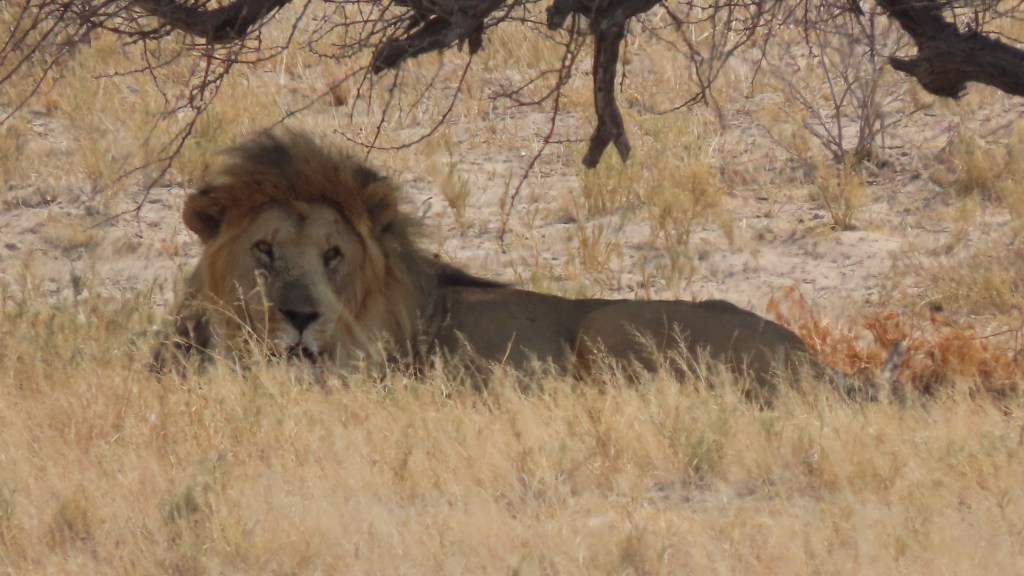
Most visitors to Etosha are eager to spot lions and rhinos, while the more ambitious might also hope to glimpse a cheetah or leopard. To maximize your chances of seeing big cats, head out on the early morning game drives that leave the lodges before the gates open. Big cats are most active during the early morning when it’s still cool. Otherwise, always look under trees, where lions can occasionally be spotted resting once the sun intensifies.
For seeing rhinos, early morning, dusk, and evening are the best times. While you can spot them at waterholes, and occasionally wandering along the side of the road, you’re likely to have the most luck at your lodge’s waterhole. Although rhinos have been hunted to near-extinction, Etosha still has a significant population of both black and white rhinos (this article explains the difference between the two types). Over the course of two days in the park, we saw nearly a dozen rhinos, including both black and white ones.
Elephants and giraffes are both relatively common sights, and you’re just as likely to see them hanging out at the waterhole as you are to see them walking along the side of the road.
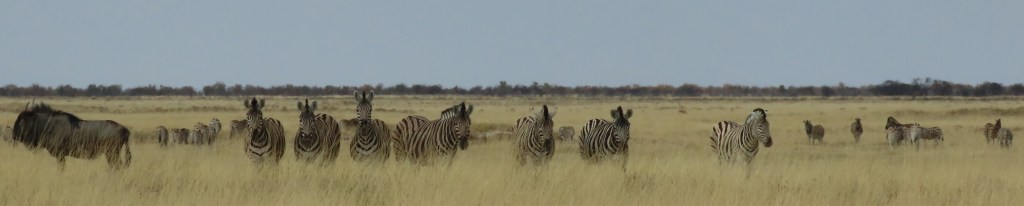
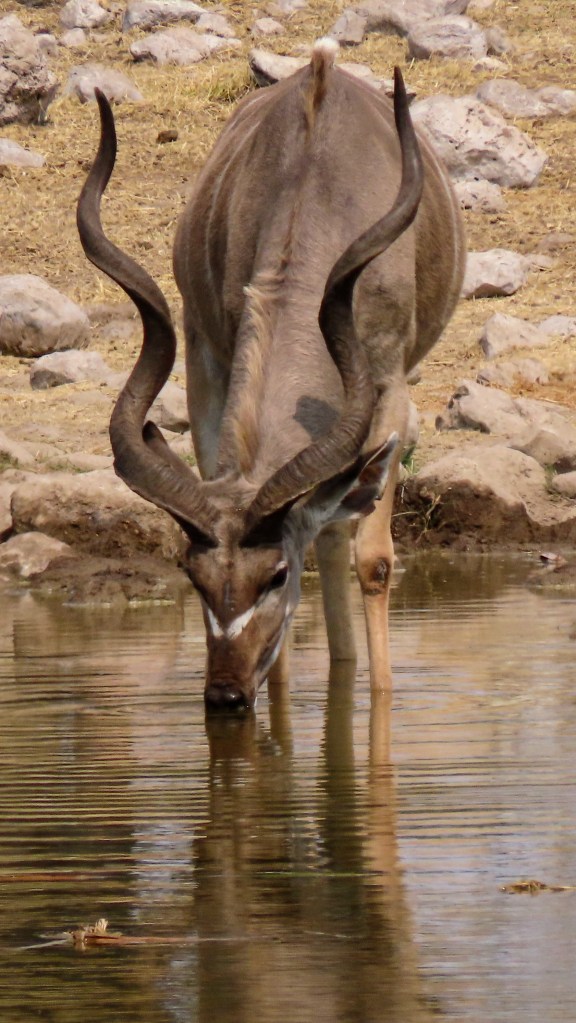
Springbok and zebra are the most common animals at Etosha, and the only animals you’re guaranteed to see during your trip, or so quipped a guide we had. Other animals you’re likely to encounter are oryx, kudu, red hartebeest, wildebeests, jackals and hyenas.
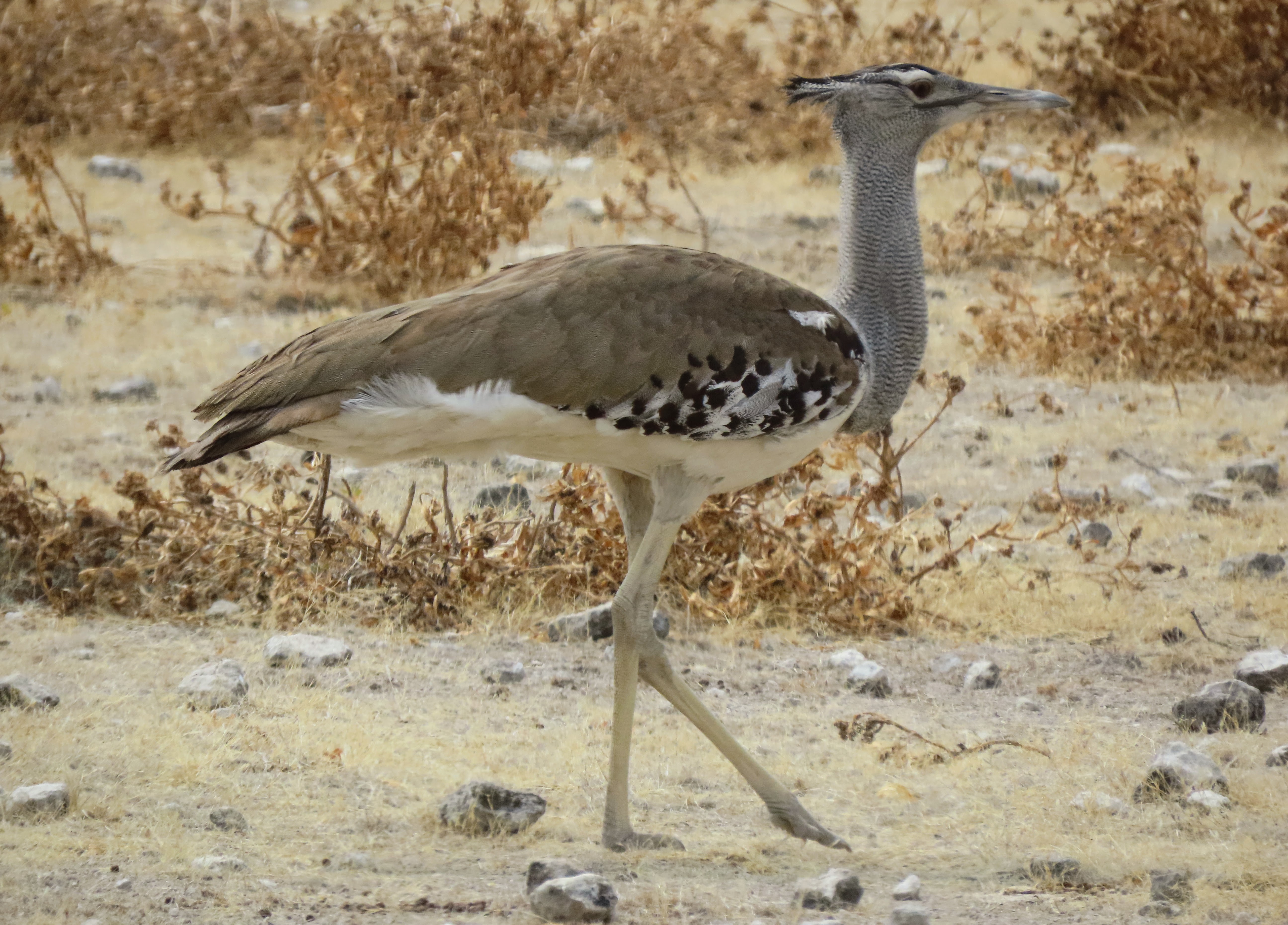
During the dry season there’s minimal bird life, but you can still expect to see kori bustard, lilac-breasted rollers, and ostrich to name a few. And in the rainy season, Etosha is home to over 340 bird species.
We highly recommend purchasing an animal identification guidebook that’s unique to Etosha. The Bradt Namibia guidebook has a good overview of many of the animals you can expect to see. Otherwise, stop in a tourist shop at one of the lodges where there should be a variety of pamphlets to help you identify and track the animals you see.
Each lodge will also have a log book, where you can find out where other guests have seen certain animals. These are most useful for cats and herds of elephants. You should not record rhino sightings, which could potentially tip off poachers to the animal’s location.



How Long Should I Spend in Etosha National Park?
Out of everywhere you visit in Namibia, you’re going to want to devote the largest chunk of time to exploring Etosha. We spent three nights and two full days in the park, and could have happily added on more.
Spending more time means more opportunities to see animals. This is especially beneficial if you’re super keen on seeing a particular animal.
Devoting more time to Etosha also means you can stay at the various lodges within the park, each of which has a unique ambiance. Each lodge also has its own waterhole, which attracts different animals. Since the park is so huge, it also means you’ll be able to spend time exploring the unique landscapes that divide the park.
If you’re following the common circular loop of the country – which we explain in our post introducing Namibia – then you’ll need to decide whether you want to start or end your trip at Etosha. Etosha will be one of the highlights, so ending there can mean ending your trip on a high note. However, driving through the area is also an approachable way to get comfortable with the hours on the road that await you later on.
How Do I Reach Etosha National Park?
There are three gates that you can use to enter Etosha National Park. By far the most common is the Andersson Gate. This gate is situated on the C38, which runs north from Windhoek, splitting from the B1 at Otjiwarongo. Once you enter the park, you’re about a twenty minute drive from the first lodge, Okaukuejo, and well-situated for visiting waterholes in the park’s southern portion.
The other gates are the Von Lindequist Gate, located on the park’s eastern edge, close to Namutoni; King Nehale Gate, in the north east; and Galton Gate, located on the far west edge, close to Dolomite Lodge, and which can only be used by guests staying at Dolomite.
Regardless of which gate you enter, the hours are the same: they open fifteen minutes after sunrise and close fifteen minutes before sunset.
Keep in mind when planning your route that driving is not permitted within the park following sunset. You’ll need to save time upon arrival to pay your park fees and reach your lodge before sundown. Don’t arrive at the main gate at sundown and think you’ve made it!

Where Should I Stay In Etosha National Park?
After deciding how much time you’ll spend in Etosha, you need to determine where you’ll stay around the park. You can opt to stay at one of the five lodges within the park, or a lodge just outside of the gates. Including time needed to show documentation at the gates and pay your park fee, it will take about an hour from entering Etosha to arriving at your first waterhole. Staying at a lodge in Etosha slashes that time, making it a much better option for safari-goers.
We recommend staying at multiple lodges during your stay in Etosha to maximize the variety of landscapes and animals you see. Some animals prefer certain parts of the park. If there’s an animal you’re keen to see, spend time in their preferred habitat. Again, there’s no guarantee this will lead to a sighting, but it will increase your chances.
While the lodges are located within the park, they do not provide all-day access. Each lodge is protected by a gate that opens at sunrise and closes at sunset. Most lodges offer early morning and night game drives that will enable you to sneak out of the lodge in advance of the gate openings or after they close.
Be aware that these lodges fill up fast during the high-season between July and September. Consider booking up to a year ahead to secure your spot.


Here’s a breakdown of the different lodges you’ll have to choose from:
- Okaukuejo – This is the first lodge you’ll approach when entering through the well-trafficked Andersson Gate. Okaukuejo is arguably the most popular lodge in Etosha. It offers a range of accommodation, from two-story waterhole-facing chalets to campsites. There’s also a pool, a restaurant, a gas station and a tower that you can climb for views of the surrounding area. The waterhole has a large viewing platform and a good reputation for lion and rhino sightings. If you enter through Andersson Gate, you’ll stop at Okaukuejo to pay your park fees. This lodge is a great option if you plan to arrive at Etosha late in the day or need to depart early in the morning.
- Halali – Located 86km from the Andersson Gate and nearly 70km from Okaukuejo, Halali is a great option if you plan on arriving in the afternoon or have time to spare when you’re leaving. Halali has a large camping area as well as private rooms. Its waterhole is tucked away in an area shaded by mopane trees and is supposed to be one of the best places to see leopards in the park (we saw one!). It also attracts elephants, rhinos, owls, and many smaller animals. From Halali, you’re well-positioned for exploring either the western or eastern reaches of the park.
- Namutoni – While it’s 151km from Andersson Gate to Namutoni, it’s just an 11km drive from the eastern Von Lindequist Gate. The lodge occupies a former German police barracks and has a much quieter ambiance than either Halali or Okaukuejo. You’ll have your pick between chalets or camping. There’s also a pool, restaurant, and a small museum. This eastern stretch of the park has a very different set of animals than in the rest of the park and is one of the few spots for seeing Damara Dik Diks. Namutoni’s waterhole is one of the best places to see cheetahs. If you’re interested in exploring the isolated northeastern parts of Etosha, it’s a great place to base yourself.
- Dolomite – Reaching Dolomite in the far west of the park takes some work. It’s 170km from Okaukuejo, best reached by the Galton Gate. The area was previously restricted to all visitors and is currently open only to people staying at the lodge. This lack of tourism has protected the animal population and it’s one of the best areas of the park for seeing rare white rhinos. The accommodation is luxurious with only 20 private chalets and a swimming pool with a scenic overlook. If you have time to spare, this is a luxury-level option to consider.
- Olifantsrus – Located halfway between Dolomite and Okaukuejo, Olifantsrus is an isolated option for campers. Compounding the isolation is the fact that there are only ten pitches here. This is the only camp that doesn’t offer game drives or a waterhole, but instead has a sheltered lookout point from which to admire the animals. It’s a unique experience, but one best limited to people who have ample time to explore the park.
- Onkoshi – If you’re seeking true seclusion, Onkoshi delivers. The lodge is located in the park’s far northeastern reaches, well away from the roads. There’s no camping here and only fifteen chalets, all of which look out onto the pan. It’s a long drive from any gate or waterhole, but you can join a game drive to explore. Unless you have a long time to spend in Etosha, this isn’t going to be the best option for most visitors looking to maximize their chances to spot animals.
Our tip: We recommend staying for a minimum of three nights in the park and choosing two lodges to stay at during that time. Picking between Okaukuejo, Halali and Namutoni will be the best option for most visitors to Etosha.
Driving in Etosha
When visiting Etosha, you’ll spend the majority of your day in your car. It’s forbidden to get out of your car in the park, except when you’re at a lodge.
Like all national parks in Namibia, the speed limit in Etosha is 60 kilometers per hour. While the C38, the main road that runs through along the southern portion of the park, is in good repair, many of the smaller tracks you’ll drive to reach the waterholes are not.
As you try to spot big cats coming out to the water holes in the evening, keep in mind that every campsite within the park is gated and closes at sunset. Always budget for extra drive time. It’s extremely likely that you’ll encounter animals crossing or standing in the road when driving during the day or evening. Whether it’s a stubborn herd of zebras or a slow-moving pack of elephants, just come to a stop and let them cross. And take some photos while you wait!
How Should I Spend My Time at Etosha?
In the beginning of this post, we said that your time at Etosha will be spent driving between waterholes. And while that’s true, there’s a little more nuance and timing to consider if you’re set on maximizing the amount and variety of animals you see.
Early morning, dusk and evening are the most active times for animals. It’s essential to start your day at sunrise, as soon as the park gates open, if you want to see big game. You can also join a game drive, which are organized by the lodges and let you leave the gate outside of official hours.
The afternoon heat drives away most animals, so consider spending your afternoon lounging poolside, or visiting the pan. Head back out in the early evening to spot some more animals, or simply park yourself by your lodge’s waterhole.

Etosha’s Vet Fence: Curiosity or Politics?
When researching Etosha, you may hear mentions of the veterinary fence that runs along the southern portion of the park. Before visiting Namibia, we heard the fence described as a border intended to prevent disease from animals in the north spreading to those in the south. We also heard it described as a strategy to keep wild animals in Etosha separate from domesticated animals outside of the park.
When we arrived in Namibia, we heard a different story. According to one of our guides, the fence was put up in the twentieth century as a tool to demark German territory from that of the local Ovambo people. The Germans wanted to control the farming and movement of cattle. The locals didn’t want that. And so the Germans built a fence to prevent trade between the north and the south, keeping the north semi-autonomous, but also limited in their trade potential.
Today, the veterinary fence supposedly continues to restrict the movement of fresh meat from the northern parts of the country to the southern parts. While we’ve heard that there are occasional checks for fresh meat when leaving Etosha through the Andersson Gate, we didn’t see any evidence of this happening during our trip. Still, if you’re planning to camp after you leave Etosha, either plan a meal that doesn’t require fresh meat or budget in time for a grocery trip on your way to your next destination. If you want more tips on cooking in Namibia, check out our complete guide to camp cooking.
Also, be aware that plastic bags aren’t allowed in Etosha, or in any of Namibia’s national parks.
Guide to Waterholes in the South of Etosha
For most visitors, sticking to the waterholes along the C38 in the southern reaches of Etosha will be the best use of time in the park. This guide gives you an introduction to the different waterholes, which animals tend to frequent them and whether or not they’re worth the drive. All directions are given as if driving west to east along the C38.
Between Okaukuejo and Halali
- Pan – The first waterhole you reach on the drive along the C38 between Okaukuejo and Halali isn’t actually a waterhole but an overlook onto the salt pan. Since it’s at the corner of the pan, you don’t get the full immensity of salt stretching for miles all around you. We recommend visiting the Etosha Outlook between Halai and Namutoni instead, which lets you drive on the salt pan for a bit.
- Nebrownii – This waterhole is an easy stop off the C38 and offers wide vistas where hundreds of zebra and springbok can be found throughout the day. Lookout for elephants stopping for a dust bath.
- Olifantsbad – If you take a right off the C38 after leaving Okaukuejo, you’ll enter a small loop with multiple waterholes. Olifantsbad sits at the end of this loop when approaching from the West, preceded by Gaseb and Gemsbokvlakte. Situated amongst Mopane trees, the waterhole attracts elephants in the morning and a rotating variety of zebra, giraffe and red hartebeest throughout the day. There’s also a toilet nearby.
- Aus – Aus sits 10km east from Olifantsbad and 15km south from the main road. Be aware that it’s best visited early in the morning as the lack of vegetation keeps away most animals from mid-morning onward.
- Kapupuhedi – Back on the C38, opposite the loop that includes Aus and Olifantsbad, Kapuphedi waterhole sits at the edge of the pan and is a reliable spot for seeing birds, even in the dry season when there are fewer around.
- Homob – If you’re basing yourself at Okaukuejo for your stay, Homob is a reliable spot for seeing oryx and kudu. Otherwise, we recommend skipping this waterhole for more impressive ones that lie a few kilometers further down the road.
- Salvadora, Sueda, Charitsaub – These three waterholes are grouped together on a detour that runs along the pan side of the C38. While the tall yellow grasses supposedly make them an ideal spot for seeing big cats, even an unfruitful drive will be satisfying as the landscape has the unique appearance of beachy sand dunes.
- Detour, pan side – Driving between Okaukuejo and Halali, you’ll find two detours, one on the pan side of the C38, the other to the south. We recommend driving the 14-kilometer route on the pan side, which starts just after you return to the C38 from Charitsaub. Supposedly a good loop for spotting lions and rhinos, the landscape itself is striking and will make the route feel satisfying even if you don’t see any animals
- Rietfontein – While the views at Rietfontein are unremarkable – it’s a large open field without much around – this waterhole is popular and worth a stop as it’s regularly teeming with animals. In the middle of the day, you’ll find herds of springbok and zebra, while in the early evening, you may spot elephants, rhinos and lions.
From Halali to Namutoni
- Etosha Pan Lookout – While you’re unlikely to see any animals at the Etosha Pan Lookout, the seemingly unending vista over the pan is worth the slow eight kilometer drive off the C38. Roll down the windows and smell the beachy breeze, redolent of the salt the stretches for miles all around you.
- Goas – This waterhole isn’t as remarkable as some further down the road. But it is right alongside it, and so worth a stop if you have time. Expect to see mostly springbok, zebra and wildebeest. When leaving, head back west then north to the C38 – the road east is heavily corrugated.
- Rhino Drive – This 40km track runs south off the C38, meandering through a variety of mini biomes. If you have the time, take this track to see vast herds of grazing zebras, springbok, and hartebeests.
- Springbokfontein – This waterhole lets you know what to expect in its name: the ever-present springbok. It’s visible from the C38, so you will be able to immediately tell if there are animals present.
- Batia – Located directly across from Springbokfontein, Batia offers a greater chance to glimpse a variety of animals, thanks to its more secluded positions three kilometers off the road. The area is rocky with some shrubby grasslands, visually distinct from the areas around it. The low-lying grasses also makes this a likely area to spot smaller animals, like hyena and jackals. Be aware you may need to drive through some mud and water to get here.
- Okerfontein – Located on a detour that goes along the edge of the pan, you’ll have a great view of the waterhole from the parking lot at Okerfontein, but the bumpy road to reach it will make you think twice. If you choose to stop here, visit as you’re driving from the east, from Halali to Namutoni, where the road is in slightly better repair than the western approach.
- Kalkheuwel – Prepare yourself for a bumpy ride when you head to Kalkheuwel, but know that the vista that awaits you is worth the trouble. This natural waterhole attracts an Edenic quantity of animals. The waterhole sits on a slight slope up from the parking lot and which makes it easy to appreciate the bounty.
- Chudop – Chudop is an artisan waterhole, which means it has a deep base of natural water – something animals love. While you’re unlikely to spot elephants here, this is purportedly a good place for spotted hyena and lions in the morning. At other points, stop by for a good chance of seeing an eland, a large type of antelope that’s more plentiful here in the eastern portion of the park by Namutoni.
- Koinachas– Located right off of the C38, Koinachas is one of the first waterholes you’ll see, if you choose to stay in Namutoni. This waterhole is deep and full of reeds which makes it popular with elephants looking to cool off and eat. It’s pretty on its own, without animals, and worthy of a stop.

From Okaukuejo up north
- Wolfsnes – Wolfsnes is another place from where you can look out onto the pan, but the rough drive makes this outlook skippable.
- Okondeka – This isolated waterhole at the edge of the pan provides an altogether unique ambiance compared to the shrub-dotted ones that sit to the south. While the waterhole is tiny and faraway from the parking lot, especially in the dry season, you’ll be surprised to find animals like oryx and springbok standing around. It may be isolated, but don’t overlook this waterhole. The low grasses on the approach also provide an excellent spot for resting lions, just be sure to check under trees in the middle of the day.
- Ghost Tree Forest – Alternately called the spooky forest, this area is filled with mopane trees. While it’s a bit of a drive away from Okaukuejo (in the direction of the restricted Dolomite camp), consider a stop here if you have time and want to see yet another strikingly different landscape. There isn’t a waterhole here, just a unique landscape within the park.
 Roam The Reaches